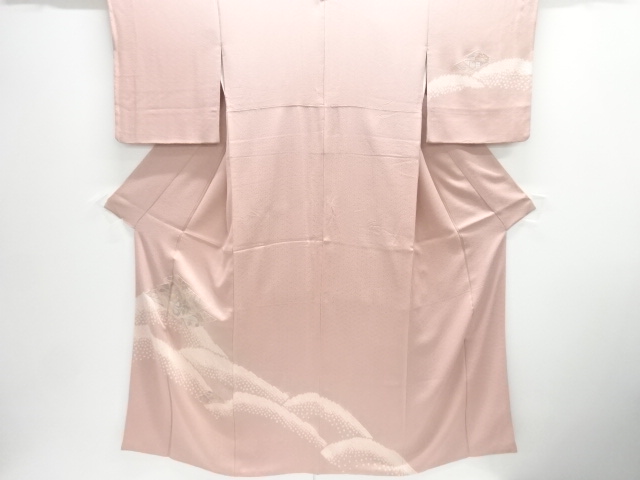
Some slight spots, blemishes, but otherwise in very good condition.
For those who appreciate its vintage nature. * Items come with everything pictured (e.g. boxes, accessories, etc. if any).
* Please read through our store policy pages before ordering. Our store primarily sells vintage & antique wares.
Please understand that age affects both item condition and value as a collectible.
Check the condition in each photo carefully to help you decide whether to bid or buy.
If there is anything specific you would like to know about this item, please contact us.
Item Code:7794136
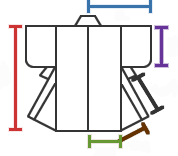
Size (cm)
Length
163 (15)
Sleeve width at shoulder
64 (4)
Sleeve width
49
Rear width
29.5
Front width
24.5
Under the skirt
76
()...extra fabric in the seams
?Ask about this item
You must be logged in to ask a question.
Please log in and try again.
[ Shibori ]
Japanese resist-dyeing technique whereby fabric is folded, twisted, scrunched, or otherwise shaped into place, tied with knots, and then dyed indigo. The knots "resist" the dye, resulting in unique patterns that consist of colored and uncolored areas. In Japanese, "shibori" means to wring or squeeze.
Shibori has been used to dye patterns on silk in Japan since the eighth century.
"Kara-shibori" is a technique to make shrinks on a textile, without dyeing.
[Shantou Drawnwork]
One of the the four main styles of Chinese silk embroidery. Shantou drawnwork originated in Suzhou located in the east Guangdong. It is said that missionaries had introduced the skill of European drawnwork after Treaty of Tianjin in 1858, and it developed Shantou Drawnwork that has beautiful Chinese style patterns.
[Suzhou Embroidery / Su Embroidery]
Suzhou Embroidery, also known as Su embroidery, is the most celebrated of the four main styles of Chinese silk embroidery produced in Suzhou and surrounding towns of Jiangsu province. has a history of about 2,000 years, originating in the Three Kingdoms Period (220-280).
Su embroidery is known for its delicacy and elegance. The threads usually are as fine as human hair made of 100% silk. Su embroiderers usually split each silk strand into thinner threads, and its stitching is smooth, dense, thin and delicate.
-
Confirmation
Your question will be posted on the item page.
When answered, it will appear in the "Questions & Answers" section.
If the content is inappropriate, contains personal information, or is deemed unsuitable, it may not be answered or posted.
If everything is okay, please press "Submit".
Submitting...
SALE
JAPANESE KIMONO / HOMONGI / SILK / EMBROIDERY / SHIBORI / PINE & FLOWERS
Some slight spots, blemishes, but otherwise in very good condition.
For those who appreciate its vintage nature. * Items come with everything pictured (e.g. boxes, accessories, etc. if any).
* Please read through our store policy pages before ordering. Our store primarily sells vintage & antique wares.
Please understand that age affects both item condition and value as a collectible.
Check the condition in each photo carefully to help you decide whether to bid or buy.
If there is anything specific you would like to know about this item, please contact us.
Item Code:7794136
[ Shibori ]
Japanese resist-dyeing technique whereby fabric is folded, twisted, scrunched, or otherwise shaped into place, tied with knots, and then dyed indigo. The knots "resist" the dye, resulting in unique patterns that consist of colored and uncolored areas. In Japanese, "shibori" means to wring or squeeze.
Shibori has been used to dye patterns on silk in Japan since the eighth century.
"Kara-shibori" is a technique to make shrinks on a textile, without dyeing.
[Shantou Drawnwork]
One of the the four main styles of Chinese silk embroidery. Shantou drawnwork originated in Suzhou located in the east Guangdong. It is said that missionaries had introduced the skill of European drawnwork after Treaty of Tianjin in 1858, and it developed Shantou Drawnwork that has beautiful Chinese style patterns.
[Suzhou Embroidery / Su Embroidery]
Suzhou Embroidery, also known as Su embroidery, is the most celebrated of the four main styles of Chinese silk embroidery produced in Suzhou and surrounding towns of Jiangsu province. has a history of about 2,000 years, originating in the Three Kingdoms Period (220-280).
Su embroidery is known for its delicacy and elegance. The threads usually are as fine as human hair made of 100% silk. Su embroiderers usually split each silk strand into thinner threads, and its stitching is smooth, dense, thin and delicate.
-
Item Code:7794136
Size (cm)
Length
163 (15)
Sleeve width at shoulder
64 (4)
Sleeve width
49
Rear width
29.5
Front width
24.5
Under the skirt
76
()...extra fabric in the seams
?Ask about this item
You must be logged in to ask a question.
Please log in and try again.
Confirmation
Your question will be posted on the item page.
When answered, it will appear in the "Questions & Answers" section.
If the content is inappropriate, contains personal information, or is deemed unsuitable, it may not be answered or posted.