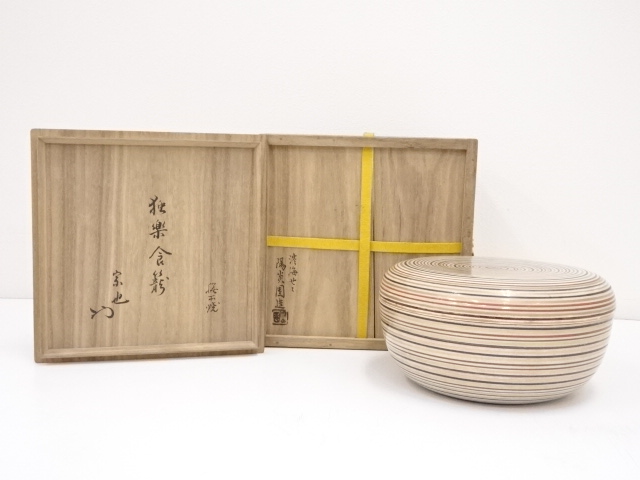
This item will be shipped as is (i.e. the same condition it was in when originally purchased from the antique dealer). * Items come with everything pictured (e.g. boxes, accessories, etc. if any).
* Please read through our store policy pages before ordering. Our store primarily sells vintage & antique wares.
Please understand that age affects both item condition and value as a collectible.
Check the condition in each photo carefully to help you decide whether to bid or buy.
If there is anything specific you would like to know about this item, please contact us.
Item Code:4824387
Size (cm)
サイズ
口径
高台径
高さ
縦
横
長さ
22
12.6
12.1
23.3
?Ask about this item
You must be logged in to ask a question.
Please log in and try again.
[Zeze ware]
Zeze ware is a style of Japanese pottery in Zeze, Shiga.
In the beginning of Edo period, they created tea utensils at Zeze ware kilns. In 1636, the feudal load of Zeze Domain, Tadafusa ISHIKAWA invited a tea master, Enshu KOHORI and Enshu taught potters his favorite style of tea utensils. The Zeze ware kiln is one of the best seven kilns selected by Enshu KOBORI.
Because early Zeze wares were used as gifts between feudal lords, well trained potters created them using selected materials.
In the middle of the history, potters created tea utensils under the patronage of Zeze domain.
During 1781 to 1789, the man called Odawaraya established Bairin ware but it failed soon. Then potters tried to preserve the technique of Zeze ware with the name of Suzugatani ware, still the kiln was closed because of a financial institution in 1878.
In 1919, Kenzo Iwasaki regretted the extinction of the great kiln and exerted himself to revive Zeze ware.
By his efforts, Zezeyaki got to be favored by tea masters and became famous in the Japanese tea ceremony as one kiln of Enshu's favorite today.
After Kenzo, his son Sinjo succeeded the kiln to keep the traditional Zeze ware methods.
[Shinjo IWASAKI] (1913-2009)
A Zeze ware potter in Otsu city, Shiga prefecture.
Shinjo was born as a son of Kenzo Iwasaki who revived Zeze ware. He succeeded methods and techniques of Zeze ware, which is one of the best seven kilns selected by Enshu Kohori, and made elegant tea utensils out of clay of Zeze with iron glaze and ash glaze.
1985 Received the Shiga Prefecture Cultural Award
Designated as the holder of Shiga Prefecture Traditional Crafts.
1987 Established the Museum of Zeze Ware and became the chief director.
1991 Accredited as Person of Traditional Industry Merit by Ministry of International Trade and Industry.
2009 Died at the age of 96.
Confirmation
Your question will be posted on the item page.
When answered, it will appear in the "Questions & Answers" section.
If the content is inappropriate, contains personal information, or is deemed unsuitable, it may not be answered or posted.
This item will be shipped as is (i.e. the same condition it was in when originally purchased from the antique dealer). * Items come with everything pictured (e.g. boxes, accessories, etc. if any).
* Please read through our store policy pages before ordering. Our store primarily sells vintage & antique wares.
Please understand that age affects both item condition and value as a collectible.
Check the condition in each photo carefully to help you decide whether to bid or buy.
If there is anything specific you would like to know about this item, please contact us.
Item Code:4824387
[Zeze ware]
Zeze ware is a style of Japanese pottery in Zeze, Shiga.
In the beginning of Edo period, they created tea utensils at Zeze ware kilns. In 1636, the feudal load of Zeze Domain, Tadafusa ISHIKAWA invited a tea master, Enshu KOHORI and Enshu taught potters his favorite style of tea utensils. The Zeze ware kiln is one of the best seven kilns selected by Enshu KOBORI.
Because early Zeze wares were used as gifts between feudal lords, well trained potters created them using selected materials.
In the middle of the history, potters created tea utensils under the patronage of Zeze domain.
During 1781 to 1789, the man called Odawaraya established Bairin ware but it failed soon. Then potters tried to preserve the technique of Zeze ware with the name of Suzugatani ware, still the kiln was closed because of a financial institution in 1878.
In 1919, Kenzo Iwasaki regretted the extinction of the great kiln and exerted himself to revive Zeze ware.
By his efforts, Zezeyaki got to be favored by tea masters and became famous in the Japanese tea ceremony as one kiln of Enshu's favorite today.
After Kenzo, his son Sinjo succeeded the kiln to keep the traditional Zeze ware methods.
[Shinjo IWASAKI] (1913-2009)
A Zeze ware potter in Otsu city, Shiga prefecture.
Shinjo was born as a son of Kenzo Iwasaki who revived Zeze ware. He succeeded methods and techniques of Zeze ware, which is one of the best seven kilns selected by Enshu Kohori, and made elegant tea utensils out of clay of Zeze with iron glaze and ash glaze.
1985 Received the Shiga Prefecture Cultural Award
Designated as the holder of Shiga Prefecture Traditional Crafts.
1987 Established the Museum of Zeze Ware and became the chief director.
1991 Accredited as Person of Traditional Industry Merit by Ministry of International Trade and Industry.
2009 Died at the age of 96.
Item Code:4824387
Size (cm)
サイズ
口径
高台径
高さ
縦
横
長さ
22
12.6
12.1
23.3
?Ask about this item
You must be logged in to ask a question.
Please log in and try again.
Confirmation
Your question will be posted on the item page.
When answered, it will appear in the "Questions & Answers" section.
If the content is inappropriate, contains personal information, or is deemed unsuitable, it may not be answered or posted.