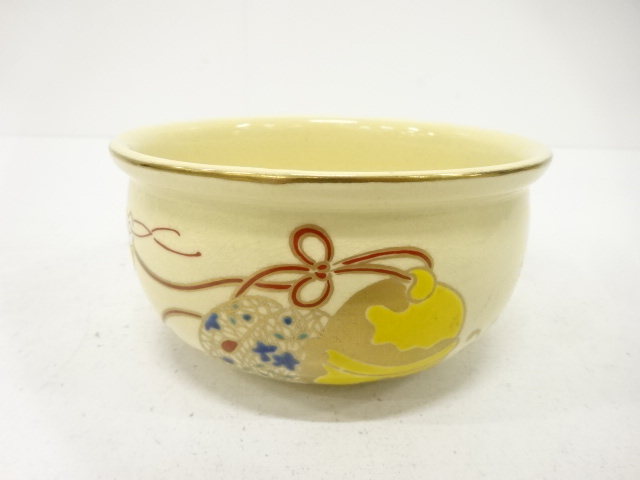
This item will be shipped as is (i.e. the same condition it was in when originally purchased from the antique dealer). * Items come with everything pictured (e.g. boxes, accessories, etc. if any).
* Please read through our store policy pages before ordering. Our store primarily sells vintage & antique wares.
Please understand that age affects both item condition and value as a collectible.
Check the condition in each photo carefully to help you decide whether to bid or buy.
If there is anything specific you would like to know about this item, please contact us.
Item Code:7659969
Size (cm)
サイズ
口径
高台径
高さ
縦
横
長さ
13
6.5
6.8
?Ask about this item
You must be logged in to ask a question.
Please log in and try again.
If you haven't signed up to our site, click here to do so.
[Iroe (polychrome pottery)]
A technique of decorating ceramics.
Iroe refers to painting motifs or patterns using lead-based red, yellow and green color glazes on the surface of glazed and fired earthenwares, porcelains, and firing them again at a lower temperature (around 800 degrees C) so the colored glaze melts onto the underglaze.
Arita ware is one of the representative iroe ceramics in Japan.
[ Kinsai ]
Gold paint/dyes used for ceramics and fabrics.
[Awata ware]
Awata ware is one style of Japanese ceramics produced in Awata area in Kyoto city, which is often said to be the earliest kiln of Kyo ware.
The first Awata ware kiln was established in Keage during the Gen’na period (1615-1624) by Sanmojiya Kyuemon who was a potter from Seto, and kilns flourished under the protection of Shoren’in (a Buddhist temple, also known as the Awata Palace) in the Edo period. In the Meiji period, Awata ware adopted styles of Satsuma ware with sophisticated designs of traditional Kyo ware, and they were called “Kyo-Satsuma”. Many of Kyo satsuma products were exported to overseas, and it became very popular there.
Confirmation
Your question will be posted on the item page.
When answered, it will appear in the "Questions & Answers" section.
If the content is inappropriate, contains personal information, or is deemed unsuitable, it may not be answered or posted.