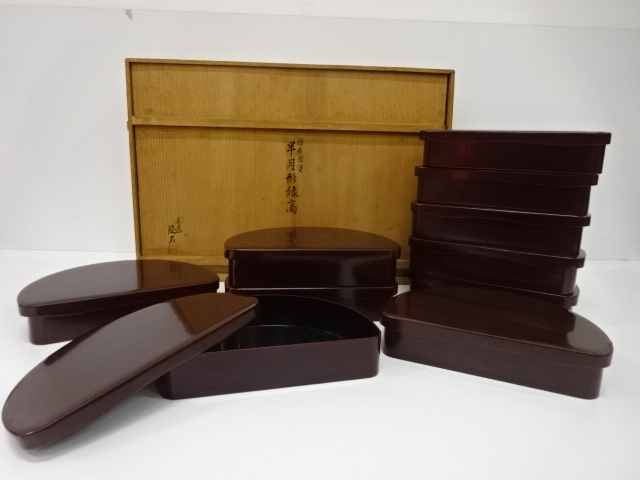
The outer box is damaged.
Two of the dishes have small chips and peeling paint.
Other items have stains and scuffs.
They are in very good condition. * Items come with everything pictured (e.g. boxes, accessories, etc. if any).
* Please read through our store policy pages before ordering. Our store primarily sells vintage & antique wares.
Please understand that age affects both item condition and value as a collectible.
Check the condition in each photo carefully to help you decide whether to bid or buy.
If there is anything specific you would like to know about this item, please contact us.
Item Code:7672502
Size (cm)
サイズ
口径
高台径
高さ
縦
横
長さ
6.5
19
28.5
?Ask about this item
You must be logged in to ask a question.
Please log in and try again.
[Kinsa KAWABATA]
A Nushi (lacquer painter).
-First Generation
His real name was Sabei, art name was Ohu.
The Kawabata family was originally from Shiga, and it is said that the first generation Kinsa ran the oil dealer in Kyoto around the end of Edo period.
He was a person of refined taste who liked Haiku and Japanese drawings. He was strongly interested in lacker wares and it became his family business.
His oldest son was Gyokusho Kawabata, a well-known Japanese painter in Meiji period, and his second son succeeded his name.
Second Generation: Kinsa
In 1864, he moved to Osaka because Conspiracy of Hamaguri-gomon Gate occurred. After then, the Kawabata family has lived in Osaka until today.
Third Generation: Kinsa
There are quite few his works left today, but rarely we can see his tea caddy which was made to cerebrate his 77th birthday.
Fourth Generation: Kinsa
He was active in Taisho and Showa period.
Fifth Generation: Kinsa (1915-1999)
His real name was Sahee who was born in Nara, and he was adopted by the 4th generation Kinsa in 1941. He became a discipline of the 4th at the age of 12 in 1928 and succeeded the 5th generation of Kinsa Kawabata n 1963.
Attracted by the culture of tea ceremony, he devoted himself to make tea utensils only since 1960.
He won several prizes and received the Osaka Prefecture Lifetime Achievement Award in 1981 and 1984.
Sixth Generation: Kinsa (1947-)
He was born in Osaka as the oldest son of the 5th Kinsa. He succeeded the 6th generation Kinsa Kawabata in 2000.
Confirmation
Your question will be posted on the item page.
When answered, it will appear in the "Questions & Answers" section.
If the content is inappropriate, contains personal information, or is deemed unsuitable, it may not be answered or posted.
If everything is okay, please press "Submit".
Submitting...
SALE
Kawabata Chikazou, Tame-nunome-nuri, half-moon shape, high rim, set of 10
The outer box is damaged.
Two of the dishes have small chips and peeling paint.
Other items have stains and scuffs.
They are in very good condition. * Items come with everything pictured (e.g. boxes, accessories, etc. if any).
* Please read through our store policy pages before ordering. Our store primarily sells vintage & antique wares.
Please understand that age affects both item condition and value as a collectible.
Check the condition in each photo carefully to help you decide whether to bid or buy.
If there is anything specific you would like to know about this item, please contact us.
Item Code:7672502
[Kinsa KAWABATA]
A Nushi (lacquer painter).
-First Generation
His real name was Sabei, art name was Ohu.
The Kawabata family was originally from Shiga, and it is said that the first generation Kinsa ran the oil dealer in Kyoto around the end of Edo period.
He was a person of refined taste who liked Haiku and Japanese drawings. He was strongly interested in lacker wares and it became his family business.
His oldest son was Gyokusho Kawabata, a well-known Japanese painter in Meiji period, and his second son succeeded his name.
Second Generation: Kinsa
In 1864, he moved to Osaka because Conspiracy of Hamaguri-gomon Gate occurred. After then, the Kawabata family has lived in Osaka until today.
Third Generation: Kinsa
There are quite few his works left today, but rarely we can see his tea caddy which was made to cerebrate his 77th birthday.
Fourth Generation: Kinsa
He was active in Taisho and Showa period.
Fifth Generation: Kinsa (1915-1999)
His real name was Sahee who was born in Nara, and he was adopted by the 4th generation Kinsa in 1941. He became a discipline of the 4th at the age of 12 in 1928 and succeeded the 5th generation of Kinsa Kawabata n 1963.
Attracted by the culture of tea ceremony, he devoted himself to make tea utensils only since 1960.
He won several prizes and received the Osaka Prefecture Lifetime Achievement Award in 1981 and 1984.
Sixth Generation: Kinsa (1947-)
He was born in Osaka as the oldest son of the 5th Kinsa. He succeeded the 6th generation Kinsa Kawabata in 2000.
Item Code:7672502
Size (cm)
サイズ
口径
高台径
高さ
縦
横
長さ
6.5
19
28.5
?Ask about this item
You must be logged in to ask a question.
Please log in and try again.
Confirmation
Your question will be posted on the item page.
When answered, it will appear in the "Questions & Answers" section.
If the content is inappropriate, contains personal information, or is deemed unsuitable, it may not be answered or posted.