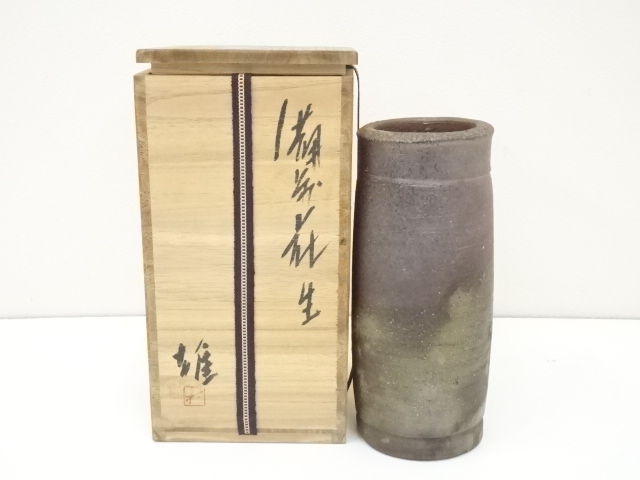
An authentic artwork by Yu Fujiwara, a living national treasure of Japan. Excellent condition. NOTE : Fragile. This item will be shipped as is (i.e. the same condition it was in when originally purchased from the antique dealer). * Items come with everything pictured (e.g. boxes, accessories, etc. if any).
* Please read through our store policy pages before ordering. Our store primarily sells vintage & antique wares.
Please understand that age affects both item condition and value as a collectible.
Check the condition in each photo carefully to help you decide whether to bid or buy.
If there is anything specific you would like to know about this item, please contact us.
Item Code:6135224
Size (cm)
サイズ
口径
高台径
高さ
縦
横
長さ
7.3
10
24.8
?Ask about this item
You must be logged in to ask a question.
Please log in and try again.
[Bizen Ware]
One style of Japanese pottery that has been made in Bizen city, Okayama prefecture.
Bizen ware is one of "Six Old Kilns of Japan” (Seto/Tokoname/Tanba/Echizen/Shigaraki/Bizen) and it has the oldest pottery making technique, introduced in the Heian period. Unglazed vassals had progressed and Bizen ware got to be made in the north part of Ibe area in Kamakura period. Since then, Bizen ware has been made nearly 1000 years in Bizen area with the traditional methods.
Bizen were kilns located in Uraibe during Muromachi period then moved to Ibe area in Momoyama period. Potters created mainly vases and earthenware mortars in Uraibe though as the progress of culture of tea ceremony in the middle of Muromachi period, they got to make tea utensils under the lead of Daimyos and tea masters. In Edo period, Bizen ware developed more under the protection of Maeda family, the lord of Bizen domain. Edo period was the time when new style of Bizwn ware such as statues of lion/Hotei (one of the Seven Gods of good luck) and incense burners were created as a gifts for the Imperial Court and shoguns. Also many of daily wares/utilities such as sake bottles, water jar and mortars were made and sold in Bizen.
Today, tea utensils, drinking vassals and daily tablewares are mainly produced in Bizen.
Bizen ware is reddish brown color pottery without using any glazes and it has various patterns on surface by Kamahen (results from wood-burning kiln firing). Bizen ware has ironlike hardness because it is burned in a 1200 degree oven for about 2 weeks without glazes.
[Yu FUJIWARA] (1932-2001)
A potter who was designated as a Living National Treasure of Japan in 1996.
Yu was born in Okayama Prefecture as a son of Kei Fujiwara, a Bizen ware potter. After leaving the Japanese Literature Course of Meiji University, he worked as a magazine editor for several years, then returned to his home town to produce ceramics at his father’s studio. Adding modern sense on the traditional methods of Bizen ware, Yu produced authentic works, and received several honorific prizes both in and out of the country. Died in 2001, a the age of 69.
Confirmation
Your question will be posted on the item page.
When answered, it will appear in the "Questions & Answers" section.
If the content is inappropriate, contains personal information, or is deemed unsuitable, it may not be answered or posted.
If everything is okay, please press "Submit".
Submitting...
SALE
JAPANESE POTTERY BIZEN WARE FLOWER VASE BY YU FUJIWARA
An authentic artwork by Yu Fujiwara, a living national treasure of Japan. Excellent condition. NOTE : Fragile. This item will be shipped as is (i.e. the same condition it was in when originally purchased from the antique dealer). * Items come with everything pictured (e.g. boxes, accessories, etc. if any).
* Please read through our store policy pages before ordering. Our store primarily sells vintage & antique wares.
Please understand that age affects both item condition and value as a collectible.
Check the condition in each photo carefully to help you decide whether to bid or buy.
If there is anything specific you would like to know about this item, please contact us.
Item Code:6135224
[Bizen Ware]
One style of Japanese pottery that has been made in Bizen city, Okayama prefecture.
Bizen ware is one of "Six Old Kilns of Japan” (Seto/Tokoname/Tanba/Echizen/Shigaraki/Bizen) and it has the oldest pottery making technique, introduced in the Heian period. Unglazed vassals had progressed and Bizen ware got to be made in the north part of Ibe area in Kamakura period. Since then, Bizen ware has been made nearly 1000 years in Bizen area with the traditional methods.
Bizen were kilns located in Uraibe during Muromachi period then moved to Ibe area in Momoyama period. Potters created mainly vases and earthenware mortars in Uraibe though as the progress of culture of tea ceremony in the middle of Muromachi period, they got to make tea utensils under the lead of Daimyos and tea masters. In Edo period, Bizen ware developed more under the protection of Maeda family, the lord of Bizen domain. Edo period was the time when new style of Bizwn ware such as statues of lion/Hotei (one of the Seven Gods of good luck) and incense burners were created as a gifts for the Imperial Court and shoguns. Also many of daily wares/utilities such as sake bottles, water jar and mortars were made and sold in Bizen.
Today, tea utensils, drinking vassals and daily tablewares are mainly produced in Bizen.
Bizen ware is reddish brown color pottery without using any glazes and it has various patterns on surface by Kamahen (results from wood-burning kiln firing). Bizen ware has ironlike hardness because it is burned in a 1200 degree oven for about 2 weeks without glazes.
[Yu FUJIWARA] (1932-2001)
A potter who was designated as a Living National Treasure of Japan in 1996.
Yu was born in Okayama Prefecture as a son of Kei Fujiwara, a Bizen ware potter. After leaving the Japanese Literature Course of Meiji University, he worked as a magazine editor for several years, then returned to his home town to produce ceramics at his father’s studio. Adding modern sense on the traditional methods of Bizen ware, Yu produced authentic works, and received several honorific prizes both in and out of the country. Died in 2001, a the age of 69.
Item Code:6135224
Size (cm)
サイズ
口径
高台径
高さ
縦
横
長さ
7.3
10
24.8
?Ask about this item
You must be logged in to ask a question.
Please log in and try again.
Confirmation
Your question will be posted on the item page.
When answered, it will appear in the "Questions & Answers" section.
If the content is inappropriate, contains personal information, or is deemed unsuitable, it may not be answered or posted.